
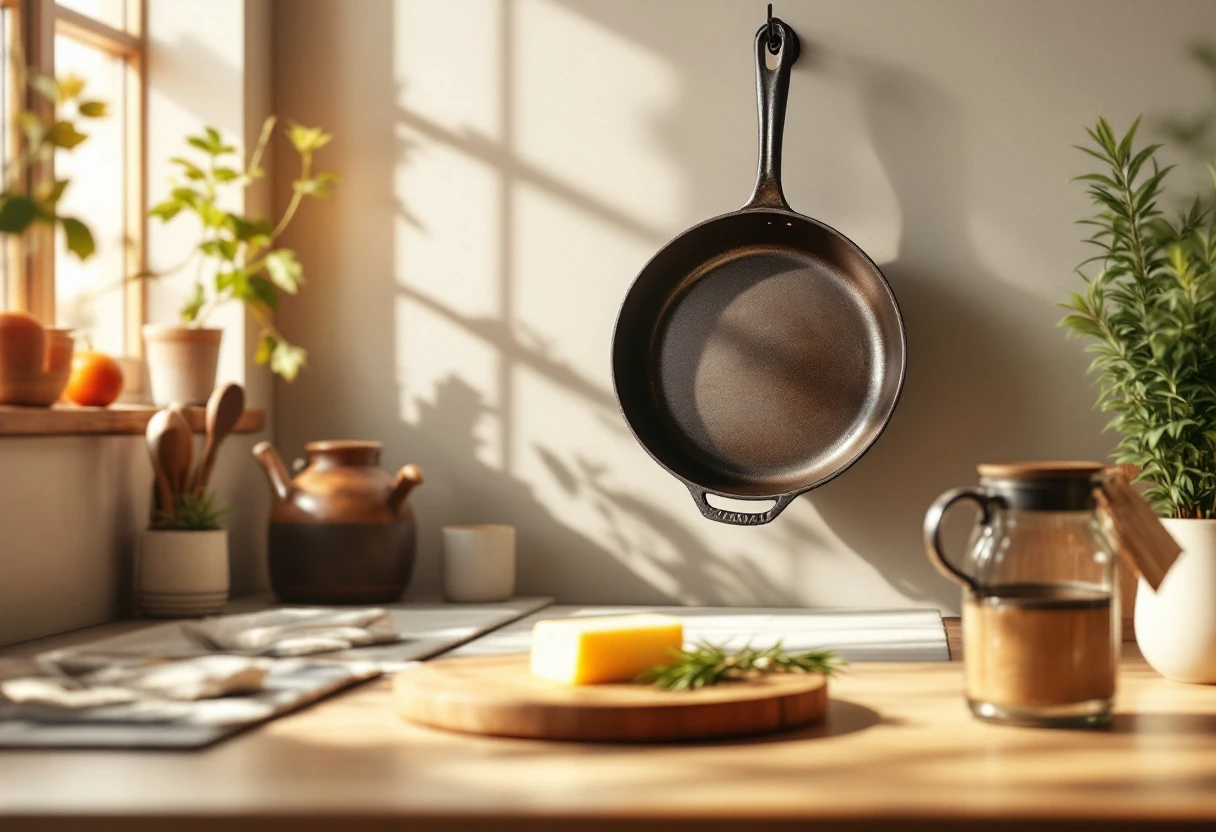
For most of my adult life I have believed that the best kitchen design decisions are subtractive. Buy less, fit less, ask each object to earn its square foot. I am still a believer. It is the reason I spent the last sixty days quietly testing a cast iron skillet that, on paper, my kitchen does not have room for.
I want to write about it because the test surprised me. Hearthstone Iron Co. sent me the pan and we agreed that the essay would run whatever I concluded. (Full disclosure at the bottom; the same rules apply here as on every sponsored review on Home Design 21.) What I concluded is that the design argument I had been running on cast iron was wrong, and that the kitchen I now have is meaningfully better for it. I have written this slowly because the conclusion is worth taking seriously.
The case I had been making against
Cast iron, as I understood it, was a romantic object. Heavy, slow, demanding. The kind of thing you write about in long-form magazines and then quietly leave on the shelf. The version I had cooked on as a teenager — my mother's, inherited from her mother — was rough, hard to season, prone to rust, and difficult to lift after a long day. I had not used a cast iron skillet in eleven years, and I had not missed one.
I had also, by then, become quietly skeptical of the heritage-object aesthetic in general. The instinct to surround oneself with brass-and-walnut "forever" objects can easily curdle into a kind of acquisitive nostalgia — buying more stuff in the name of buying less. I was wary of falling for that move with a pan.
"The instinct to surround oneself with brass-and-walnut forever objects can curdle into acquisitive nostalgia. I was wary of falling for that move with a pan."
The skillet I tested
The Hearthstone Iron Co. 10-inch is heritage cast iron in the proper sense of the word — American-poured, pre-seasoned, with a meaningfully smooth cook surface and a handle balance you can feel before you ever turn the burner on. It does not look like the rough, pebbled pan I remembered from my mother's kitchen. It looks like an object that has been thought about.
I tested it across four use cases over the sixty-day window: morning eggs (the unforgiving test), the one-pan roasted vegetables that constitute most of my weeknight cooking, a weekly steak (the high-heat test), and the cleaning routine (the test where most cast iron pans quietly lose their argument with the user).
The eggs took eleven days
I want to be honest about this part because most cast iron reviews skip past it. For the first ten mornings, the eggs stuck. Not catastrophically — Hearthstone's pre-seasoning is meaningfully better than the cast iron I remembered — but enough to make me question whether the pan was actually going to settle. On day eleven, the seasoning that I had been building up across the previous cooking quietly took, and the eggs released. By day thirty they slid. By day sixty I prefer this pan for eggs to any other pan I have cooked on, which is a sentence I would not have believed possible to write when I started this review.
The roasted vegetables are the use case that converted me
It is the slowest cooking the pan does — vegetables roasted in the oven at 425°F for forty minutes, the kind of weeknight meal where the pan is a delivery vehicle for caramelisation rather than a heat-transfer instrument. And it is the cooking that shows the heritage object's actual design argument. The thermal mass of cast iron means the pan continues caramelising the vegetables after I have turned the oven off. The same five sweet potatoes finish meaningfully more browned, with crisper edges, than they ever did in my old roasting tray. I have started leaving the oven off for the last six minutes of every roast.
The design argument I have come around to
Here is the part of the review I have been writing in my notebook for weeks before sitting down with the essay. The argument for cast iron in a small, considered kitchen is not the heritage one. It is the subtractive one — the same argument I have always made for restraint in everything else.
This single pan, in the sixty days I have been cooking on it, has replaced three:
- A medium nonstick I had been quietly planning to throw out for the fourth time. The coating had developed the small grey speckling that I no longer want anywhere near eggs my family eats.
- The cheap roasting tray I used twice a year because it took up a full cabinet shelf and was awkward to retrieve.
- A grill pan, bought hopefully, that did not survive its second cleaning cycle.
Three pans gone from the cabinet. One pan in their place — but on a hook above the stove, not behind a door. The cabinet I freed up is now where I keep the dry goods I actually use weekly, where they belong. The kitchen, sixty days in, is meaningfully more usable than it was when I started, and it contains fewer objects.
The skillet I tested
Hearthstone Iron Co. makes pre-seasoned American-poured cast iron in 8″, 10″, and 12″ sizes, plus a heritage bundle that includes a Dutch oven. The 10″ is what I cooked on. They include a printed seasoning card in the box that I now recommend just trusting; I overthought it for the first week. Mention Home Design 21 at checkout and they include the bristle brush and chainmail scrubber free.
See the skillet at Hearthstone Iron Co. →The honest list of caveats
The case I am making here is for a specific kind of cook: one who already cooks two or more times a week in a small, deliberately edited kitchen. If that is not you, my conclusion will not hold, and I would rather lose the recommendation than have it land wrongly.
- It is genuinely heavier than my old nonstick. Not unmanageably; I can lift it one-handed with eggs in it. But if you have a wrist or shoulder issue, the 8″ is a more comfortable size than the 10″ and will cover most of the same use cases.
- It cannot live in the dishwasher. I now keep a small jar of kosher salt and a folded cotton towel next to the stove. The whole cleaning routine takes under a minute.
- It looks better the more you use it. The seasoning darkens. The handle develops a quiet patina. Eleven years from now I expect to like the way it looks more than I do today, which is the opposite of what is true of every other object I own.
Would I tell a friend living in a small apartment to buy one
Yes. Specifically: I would tell a friend whose kitchen is already nearly the way they want it, who cooks for themselves or a partner most weeknights, and who has been quietly thinking about replacing a tired nonstick. That is the cook this pan is for. To everyone else — chefs by trade, weekend-only home cooks, anyone who has not yet developed a relationship with the act of cooking — I would say wait. Buy a Hearthstone after you have decided that cooking is something you actually do.
Sixty days in, I am writing this from my kitchen with the pan on the hook above the stove. It is a beautiful object. It is also a useful one. I have not yet found a third category I want it to belong to. I think that is the point.